Scuba Tanks Explained: Steel vs Aluminium, Sizes, Pressure, Air and Nitrox
The tank is the heart of 'self-contained' diving. You'll rarely own one as a beginner, but understanding it helps you plan dives and manage buoyancy.
On this page
A scuba tank (also called a cylinder or bottle) stores breathing gas at high pressure, typically 200–232 bar (about 3,000–3,400 psi). Almost every dive centre supplies tanks and fills, so most recreational divers never buy one. You'll still use one on every dive, so it's worth understanding.
Steel vs aluminium
| Aluminium | Steel | |
|---|---|---|
| Where common | Tropics, Americas, Red Sea, Asia | Europe, cold-water and technical diving |
| Weight on land | Heavier for the same gas capacity | Lighter/smaller for the same capacity |
| Buoyancy | Becomes positively buoyant near empty (+1.5–2 kg) | Stays negative; you can carry less lead |
| Durability | Doesn't rust; softer metal dents | Very tough; can rust if water gets inside |
| Price | Cheaper | More expensive |
The buoyancy difference matters. With aluminium tanks, you need enough weight to hold a comfortable safety stop at the end of the dive, when the nearly empty tank tries to float you up.
Common tank sizes
Tank size is described by internal water volume (litres, in Europe) or by gas capacity (cubic feet, in the US).
- AL80 (aluminium 80): the world's most common rental tank. About 11.1 litres water volume, 207 bar (3,000 psi) working pressure, holding roughly 2,200–2,300 litres of air.
- 12-litre steel: the standard in much of Europe, often filled to 200 or 232 bar (about 2,400–2,800 litres).
- 15-litre steel: for bigger breathers or deeper dives. Ask for one if you tend to run low on air first.
- Small tanks (3–10 L): for children, pony bottles (redundant supply) or snorkel-style shallow dives.
How long does a tank last?
It depends mainly on depth, your breathing rate and effort. Because every 10 m adds one bar of pressure, each breath at 20 m (3 bar absolute) uses three times as much air as the same breath at the surface.
| Depth | Pressure (absolute) | Air use vs surface | Approx. time on an AL80* |
|---|---|---|---|
| 0 m | 1 bar | ×1 | — |
| 10 m | 2 bar | ×2 | ~55–65 min |
| 20 m | 3 bar | ×3 | ~35–45 min |
| 30 m | 4 bar | ×4 | ~25–30 min |
*Illustrative for a relaxed diver breathing about 15–18 L/min at the surface, keeping a reserve. Beginners often use much more at first. In practice, no-decompression limits usually end deeper dives before air runs out.
To make your air last longer, breathe slowly and deeply, stay warm, move slowly, perfect your buoyancy and streamline your gear.
Air vs nitrox
- Air: about 21% oxygen, 79% nitrogen. Filtered and dried so it's clean and very dry, which is why your mouth feels dry after dives.
- Enriched Air Nitrox (EANx): 22–40% oxygen, most commonly 32%. Less nitrogen means longer no-decompression limits, but a shallower maximum operating depth (about 34 m for EAN32 at 1.4 bar PO₂). You need the Nitrox specialty to use it.
Nitrox tanks are usually marked with a green-and-yellow band or sticker. Always analyse your own nitrox and label the tank before diving.
Valves: DIN and yoke
The tank valve connects to your regulator's first stage in one of two ways:
- Yoke (A-clamp / INT): the regulator clamps over the valve. Common in the tropics and the Americas.
- DIN: the regulator screws into the valve. It's more secure, rated for higher pressure, and standard in Europe and technical diving.
Many rental tanks have convertible valves, and adapters are available. If you buy a regulator, check which type your usual destinations use.
Safety, handling and inspections
- Never leave a tank standing unattended. A falling tank can break feet or damage the valve. Lay it down or secure it in a rack.
- Open the valve fully (then some prefer a quarter turn back) and check the pressure before every dive.
- Tanks need a visual inspection (usually yearly) and a hydrostatic test (every 2–5 years depending on country). Look for date stamps and stickers.
- Don't leave full tanks in hot cars or direct sun.
- Never completely empty a tank. Keep a little pressure to stop moisture entering.
Should you buy a tank?
Usually not. Unless you shore-dive locally very often, tanks are heavy, need inspections, and are provided everywhere. Spend your money on a dive computer and your own mask first.
Frequently asked questions
How long does a scuba tank last?
For a relaxed diver at 10–12 m, a standard AL80 or 12 L tank typically lasts 45–60 minutes. At 20–30 m it lasts much less, and beginners use more air at first.
Do scuba tanks contain pure oxygen?
No. Recreational tanks contain compressed air (21% oxygen) or nitrox (usually 32–36% oxygen). Pure oxygen is toxic at depth.
Why does my aluminium tank make me float at the end of the dive?
As you breathe the air, the tank gets lighter. An AL80 goes from slightly negative when full to about 2 kg positive when nearly empty. That's why weight checks are done with a nearly empty tank.
Keep reading
Scuba Regulators Explained: First Stage, Second Stage and Octopus
First stage, second stage, octopus and SPG: how your air gets from tank to mouth.
BCD Guide: Jacket vs Back-Inflate Wing, Integrated Weights and How to Choose
Jacket, back-inflate or wing? How a buoyancy compensator works and how to choose one.
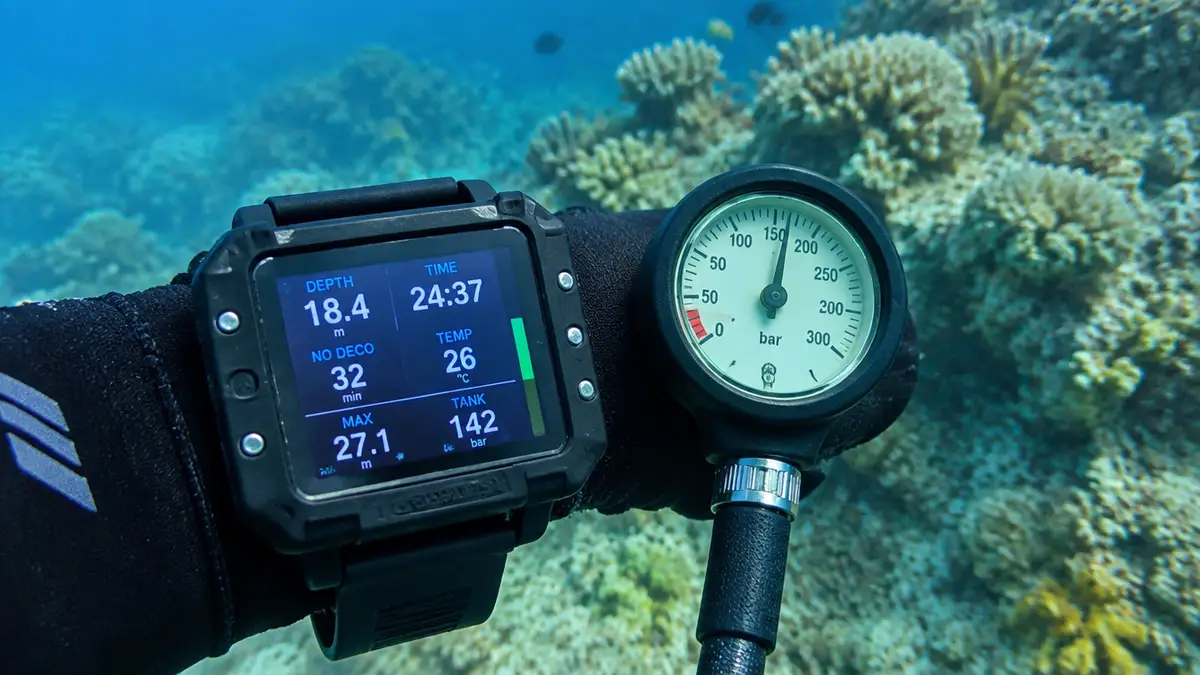
Dive Computers for Beginners: Why You Need One From Your First Dives
Why a dive computer should be your first big purchase, and which features really matter.