The Buddy System: Why You Never Dive Alone and How to Be a Good Buddy
Your buddy is your backup air supply, your second pair of eyes and your help if anything goes wrong. Recreational diving is built around this simple rule.
On this page
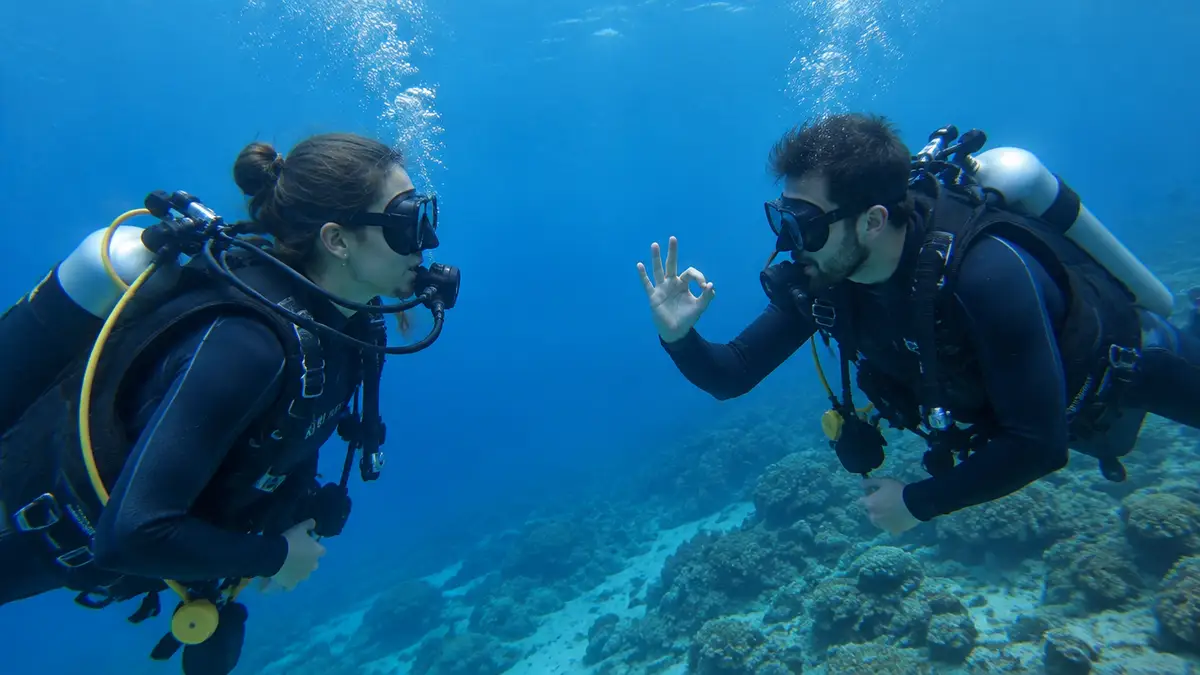
Recreational scuba training is built on one simple rule: never dive alone. You dive in pairs (sometimes threes), and each buddy is responsible for the other. It isn't a formality. Your buddy carries the spare air you'd need in an out-of-air emergency, can help you with a tangle or a cramp, and can get help if you're in trouble.
What a buddy does
- Checks your gear before the dive. See buddy check
- Stays close, within a few seconds' reach, throughout the dive
- Monitors you: air, depth, behaviour, signs of stress or cold
- Provides air from their octopus if you run out
- Helps with problems: entanglement, cramps, a loose tank, a lost fin
- Shares the experience. Pointing out a turtle is half the fun
Staying together underwater
Buddy separation is one of the most common problems, especially in poor visibility or when one diver gets distracted by a camera.
- Agree a position before the dive: side by side, or one slightly behind, and on which side.
- Stay within arm's reach in poor visibility; a few metres at most in clear water.
- Check on your buddy every 20–30 seconds, as naturally as checking a car's mirrors.
- Match your pace to the slower diver.
- Agree who leads and who navigates.
- Use lights: at night or in low visibility, torch signals and marker lights help.
Communicating underwater
You can't talk underwater, so divers use:
- Hand signals: OK, problem, low on air, go up, and many more.
- Touch: a tap on the shoulder or a squeeze of the arm.
- Sounds: tank bangers, shakers or underwater horns to get attention.
- Slates: write more complex messages.
- Torch signals: circles for "OK", fast side-to-side for "attention/problem".
Before diving with someone new, agree on your signals, especially for air pressure (numbers vary between regions and agencies).
Air sharing
If a diver runs out of air, the out-of-air diver signals "out of air" (a slashing motion across the throat) and "share air" (hand towards the buddy's mouth). The donor provides their octopus (or, in some systems, their primary regulator), they hold on to each other, and they make a slow, controlled ascent together. You'll practise this in your Open Water course. Refresh it regularly with your buddy. See what to do if you run out of air.
Lost buddy procedure
The standard procedure, taught by most agencies:
- Stop and look around for up to one minute. Turn slowly in a full circle, look up and down, and look for bubbles.
- If you can't find your buddy after about a minute, ascend slowly to the surface (doing a safety stop if appropriate).
- Reunite at the surface. Your buddy should do the same.
- If your buddy doesn't appear, alert the boat or shore team immediately.
Always confirm this in the briefing, as some guides and sites use slightly different procedures.
Dive guides and groups
When you dive with a guide, you still have a buddy. The guide is responsible for the group's route and pace, but can't watch everyone's air and depth at every moment. Stay with your buddy and the group.
How to be a great buddy
- Be honest about your experience and comfort level.
- Communicate clearly on the boat and underwater.
- Know your buddy's gear: weight release, octopus location, BCD releases.
- Stay close, even when you spot something exciting.
- Signal your air regularly and respect the agreed turn pressure.
- Respect each other's limits. The dive is only as deep and long as the less comfortable diver wants.
- Do a quick debrief after the dive: what went well, what to improve.
What about solo diving?
Some very experienced divers dive solo with full redundant equipment and specialist training ("self-reliant diver"). That's not for beginners. Until you've got substantial experience, always dive with a buddy.
Frequently asked questions
Can I scuba dive alone?
Not as a recreational diver. Solo diving requires extensive experience, redundant equipment and specialist training. Beginners should always dive with a buddy.
What if I travel alone and have no buddy?
Dive centres will pair you with another diver or a guide. It's a great way to meet people.
How long should I look for a lost buddy?
The usual rule is to search for about one minute, then ascend slowly and meet at the surface.
Keep reading
Scuba Diving Hand Signals: The Essential Signals Every Beginner Needs
OK, problem, low on air, up, down: the underwater signals you need, and how to use them.

Buoyancy and Breathing: Never Hold Your Breath, Save Air and Hover Like a Pro
Why you never hold your breath, how to find neutral buoyancy and how to make your air last longer.
How to Ascend Safely: Ascent Rate, the Safety Stop and Surfacing
Ascent speed, the 3-minute safety stop and how to surface without drama.