How to Ascend Safely: Ascent Rate, the Safety Stop and Surfacing
The last few minutes of a dive matter most for decompression safety. A slow, controlled ascent and a safety stop are habits every diver should follow on every dive.
On this page
Most decompression problems relate to how divers end a dive: ascending too fast, skipping the safety stop, or losing buoyancy control near the surface. Get your ascent right, every time, and you remove a large part of the risk.
Why ascent speed matters
During a dive, your body absorbs nitrogen. As you ascend and pressure falls, that nitrogen starts leaving your tissues. A slow ascent gives your body time to carry it to your lungs and breathe it out. Ascending too fast can allow bubbles to form, causing decompression sickness. A fast ascent while holding your breath can also cause lung overexpansion injuries (see buoyancy and breathing).
How slow is slow?
- Most agencies and dive computers specify a maximum ascent rate of 9–10 metres (30 feet) per minute, and many computers alarm if you exceed it.
- Slower is fine, and often better, especially in the last 10 metres, where the relative pressure change is greatest.
- Practical guide: ascend no faster than your smallest bubbles, and watch your computer's ascent-rate indicator.
The safety stop
A safety stop is a pause of 3 minutes at around 5 metres (15 feet) at the end of every dive. It isn't mandatory decompression in a no-decompression dive, but it's strongly recommended on every dive, and it's standard practice everywhere.
- Reduces decompression stress
- Gives you a chance to stabilise your buoyancy before the final, most sensitive part of the ascent
- Lets you check the surface above for boats
- Your dive computer usually counts it down for you
Many divers extend the stop (5 minutes or more) after deeper dives, multiple dives a day, or when they feel cold or tired. Some divers also add a "deep stop" on deeper dives, but follow your training and your computer's guidance.
A safety stop is an extra precaution. A decompression stop is mandatory and happens when you've exceeded your no-decompression limit. Recreational divers plan dives to stay within limits, so they never need decompression stops. If your computer ever shows a mandatory stop, follow it exactly, and review how it happened.
How to ascend step by step
- Signal "up" to your buddy (thumb up) and get an OK back.
- Check your computer and note the time and your air.
- Look up, raise one hand above your head (to protect it from hitting anything), and hold your inflator ready in the other.
- Begin ascending slowly, using gentle kicks or a little buoyancy.
- Vent air from your BCD in small amounts as you rise, because it expands as pressure drops. If you start to rise faster than you want, dump air right away and flare your body horizontally.
- Keep breathing normally.
- Stop at 5 m for 3 minutes. Hold position next to your buddy, a line or the reef slope.
- Complete the final 5 m very slowly (about a minute is ideal).
- At the surface: inflate your BCD, keep your regulator in or switch to snorkel, signal OK to the boat, and stay with your buddy.
Using a surface marker buoy (SMB)
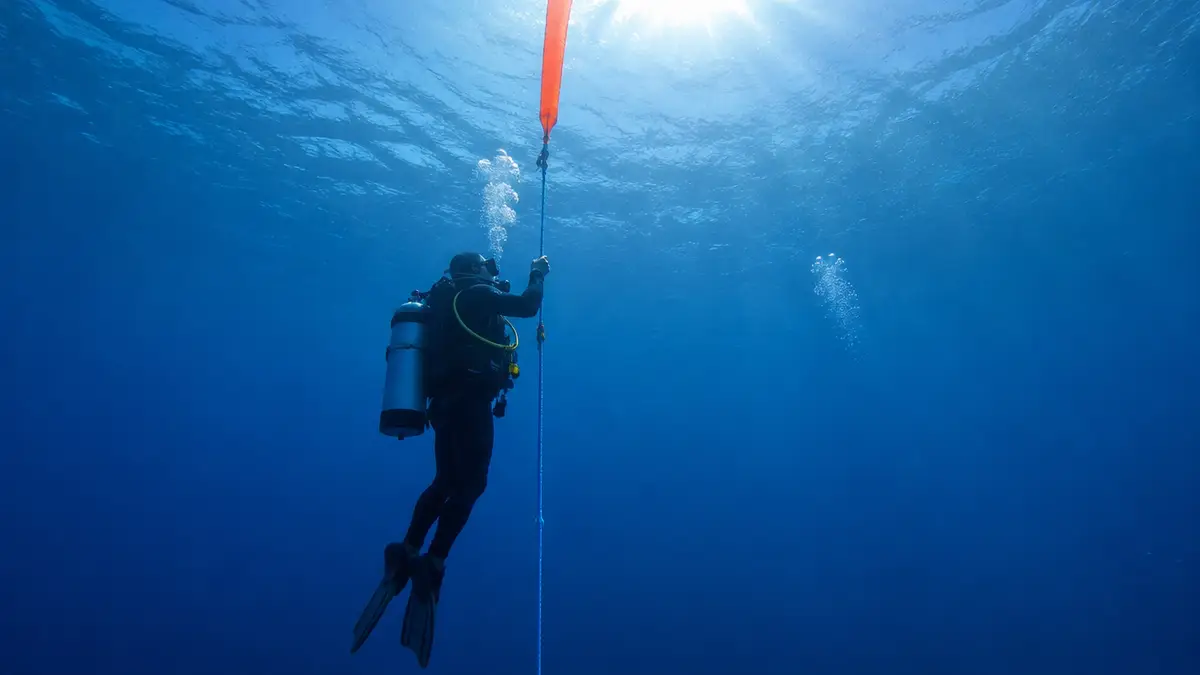
In open water, especially with currents or boat traffic, divers often deploy a delayed SMB during the safety stop to show the boat where they'll surface. It needs practice: done badly, it can drag you upward. Learn it with an instructor, or in the Advanced or drift course, before doing it yourself. See SMBs and reels.
Common ascent problems
| Problem | Why it happens | Fix |
|---|---|---|
| Rising too fast near the surface | BCD/wetsuit air expands; tank is lighter | Vent early and often; exhale; correct weighting with near-empty tank |
| Can't hold the safety stop | Underweighted; aluminium tank floats when empty | Add 1–2 kg; do a proper weight check |
| Ear pain on ascent (reverse block) | Air can't escape the middle ear | Descend a little, then ascend very slowly. See ears |
| Low on air at the stop | Started ascent too late | Agree a turn and ascent pressure (e.g. 50–70 bar) |
Emergency ascents
If you're out of air and your buddy isn't close, training covers the Controlled Emergency Swimming Ascent (CESA): look up, swim up at a controlled pace, and exhale continuously the whole way. Buddy air-sharing is always preferred if possible. See what to do if you run out of air.
Frequently asked questions
How fast should you ascend when scuba diving?
No faster than 9–10 metres (30 feet) per minute, and slower in the final 10 metres. Your dive computer will warn you if you ascend too fast.
Is the safety stop mandatory?
For a no-decompression dive, it's not technically mandatory, but it's strongly recommended on every dive and is standard practice.
What happens if I skip my safety stop?
In an emergency, surfacing is more important. Missing a safety stop occasionally doesn't mean you'll get DCS, but it removes a margin of safety. Monitor yourself for symptoms, take it easy, and consider not diving again that day.
Keep reading
What to Do If… Mask Fogs, You Run Low on Air, Lose Your Buddy or Hit a Current
Calm, practical responses to the most common underwater problems.

Ocean Etiquette for Divers: Don't Touch, Don't Feed, Don't Take
Don't touch, don't feed, don't take: how to protect the reefs you came to see.
Dangerous Marine Life for Divers (and the Truth About Sharks)
The creatures that actually injure divers are small and stationary. The truth about sharks.