Snorkeling for Beginners: How to Start, What Gear You Need and Safety Tips
Snorkeling is the simplest way to see the underwater world: just a mask, snorkel and fins. It's a perfect first step if you're not ready for scuba, and a joy in its own right.
On this page
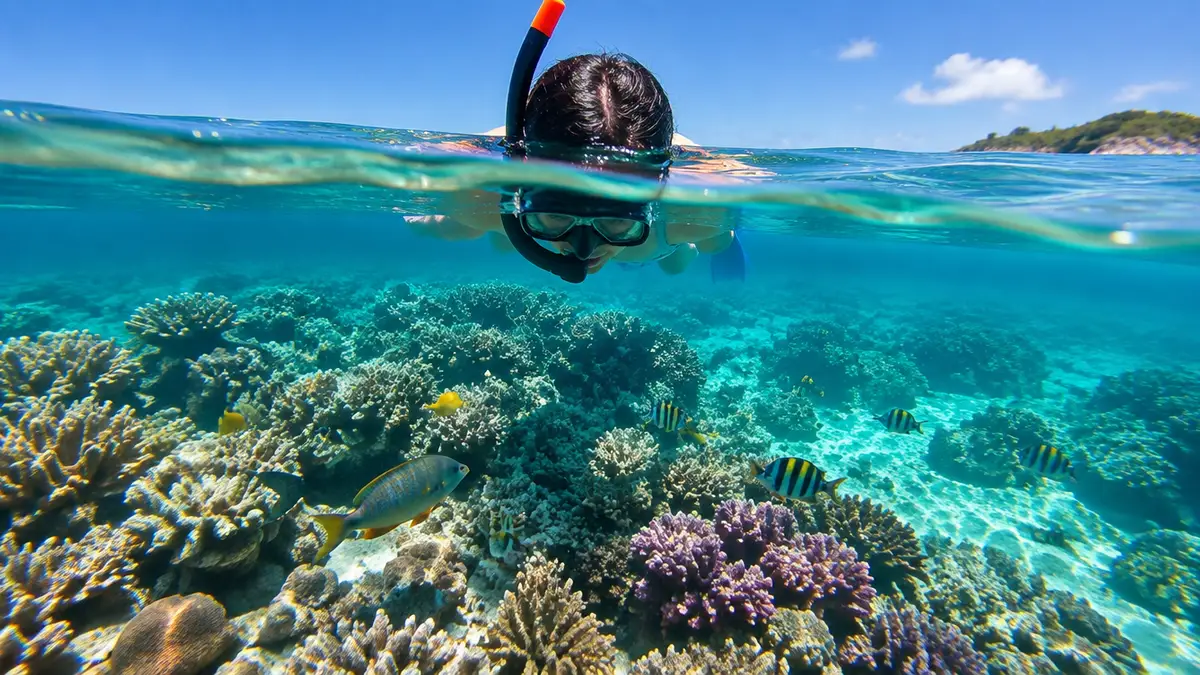
Many of the world's best reefs are shallow, and on a sunny day, floating on the surface above a colourful coral garden can be just as magical as diving. Snorkeling needs no certification, costs very little, and families can do it together. It's also a great way to find out whether you'll enjoy scuba diving.
Snorkeling vs scuba diving
| Snorkeling | Scuba diving | |
|---|---|---|
| Training | None needed (a briefing helps) | Certification course |
| Depth | Surface, with short breath-hold dips | Up to 18–40 m |
| Gear | Mask, snorkel, fins (+ vest) | Full scuba kit |
| Cost | Very low | Higher |
| Time underwater | Unlimited at the surface | 45–60 min per dive |
| Best for | Shallow reefs, families, casual exploring | Deeper reefs, wrecks, longer encounters |
The gear
Mask
Choose a proper tempered-glass mask that covers your nose. Do the fit test: place it on your face without the strap and inhale gently through your nose. It should stay in place. See our mask guide.
Full-face snorkel masks became popular for their comfort, but concerns have been raised about CO₂ build-up in some designs, and they're harder to remove quickly in an emergency. Many experts recommend a traditional mask and snorkel. If you use one, choose a reputable brand with separate breathing channels, and never use it for breath-hold diving.
Snorkel
A simple J-snorkel, a semi-dry or a dry snorkel. Dry snorkels help beginners avoid mouthfuls of water from waves. See snorkels.
Fins
Full-foot fins are comfortable for snorkeling. Short snorkeling fins are fine for calm water; longer fins give more power in currents.
Extras
- Snorkel vest or buoyancy aid: great for beginners, children and less confident swimmers
- Rash guard or thin wetsuit: protects against sunburn, which is common on your back, and against jellyfish
- Reef-safe sunscreen
- A bright swim cap or buoy so boats can see you
How to snorkel: step by step
- Practise in shallow water. Stand in waist-deep water, put your face in and breathe through the snorkel.
- Breathe slowly and deeply through your mouth. It feels strange at first but quickly becomes natural.
- Float face-down and relax. Salt water helps you float.
- Kick gently from the hips with fairly straight legs. Keep your fins under the surface to avoid splashing.
- Keep your arms relaxed by your sides.
- Clear water from your snorkel with a sharp "too!" blast of air.
- Look around regularly to check your position, your buddy and the boat.
Duck diving (going under)
With practice, you can take a breath and dive down briefly for a closer look. Bend at the waist, lift your legs straight up so their weight pushes you down, and equalize your ears early. Exhale into or blast your snorkel when you come back up. Never hyperventilate before breath-hold dives, and always have a buddy watching from the surface. See freediving.
Safety tips
- Never snorkel alone. Use the buddy system
- Check conditions: currents, waves, tides and boat traffic. Ask locals
- Enter and exit where it's easy and marked; plan your exit before you enter
- Swim against the current first, so it brings you back when you're tired
- Don't stand on coral. Float in deeper water, or rest with a buoyancy aid
- Stay hydrated and cover up against the sun
- Know your limits. Snorkeling in open water is harder than it looks, and fatigue sets in quickly
- If you get tired: roll onto your back, relax and signal for help
Where to snorkel
- Maldives: house reefs and whale sharks (South Ari)
- Red Sea: shallow reefs right off the beach, turtles at Marsa Alam
- Great Barrier Reef: outer reef pontoons
- Moalboal, Philippines: the sardine shoal and turtles
- Mexico: Akumal turtles, cenotes and whale sharks
- Belize's Hol Chan and Bonaire
From snorkeling to scuba
If you love snorkeling, you'll probably love scuba. Try a Discover Scuba session. The skills you've learned (mask comfort, finning, breathing calmly) give you a head start.
Frequently asked questions
Do you need to be able to swim to snorkel?
You should be comfortable in the water. Non-swimmers can snorkel in very calm, shallow water with a buoyancy vest and close supervision, but learning to swim is strongly recommended.
Are full-face snorkel masks safe?
There have been concerns about CO₂ build-up and difficulty removing them in emergencies. Many experts recommend a traditional mask and snorkel instead.
Keep reading
Freediving for Beginners: What It Is, How to Start and How to Stay Safe
Diving on a single breath: what freediving involves, how to learn, and the one rule you must never break.
Scuba Diving with Kids: Minimum Ages, Programmes and Safety Tips
Minimum ages, kids' programmes and how to tell whether your child is ready.
Liveaboard Dive Safaris: What They Are, Who They Suit and How to Choose
Eat, sleep, dive, repeat: how dive safaris work and whether you're ready for one.