The Dive Briefing and Pre-Dive Buddy Check (BWRAF) Explained
Most diving problems can be caught on the boat, before anyone gets wet. The briefing and buddy check take a few minutes and prevent a surprising number of incidents.
On this page
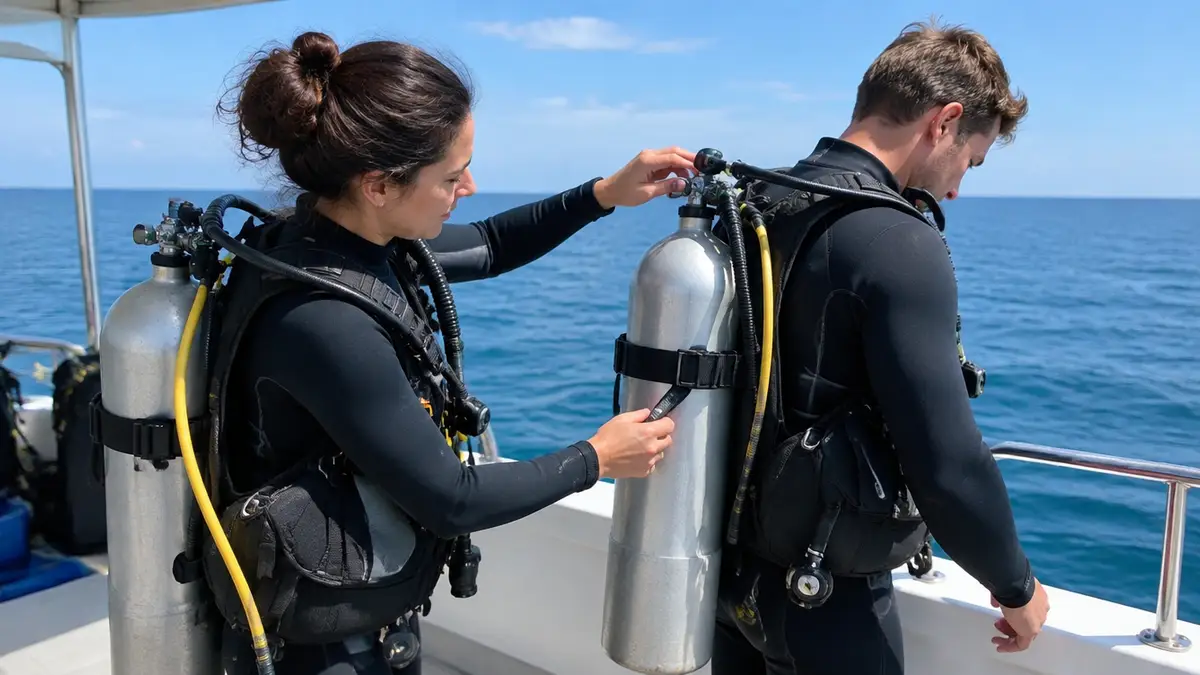
Before every dive, two routines happen: the dive briefing, where the guide explains the site and the plan, and the buddy check, where you and your buddy check each other's gear. Experienced divers still do both on every dive. Most equipment-related incidents, such as a tank valve left closed, a disconnected inflator or weights that won't release, would have been caught by a proper check.
The dive briefing
A good briefing covers:
- Site description: layout, depth range, features (reef, wall, wreck), what you might see, and a map sketch.
- Conditions: current, visibility, water temperature, surface conditions.
- Entry and exit: giant stride, back roll or shore entry; how you'll get back on the boat or out of the water.
- Dive plan: maximum depth, maximum dive time, direction, and turn-around point.
- Air management: when to signal your air, and when to start ascending (for example, "Show me your air at 100 bar; start ascending at 50–70 bar").
- Buddy teams and group order.
- Hand signals specific to this site or guide. See hand signals.
- Safety stop and ascent procedure, including whether to deploy an SMB.
- Lost buddy procedure and emergency procedures. See what to do if.
- Environmental rules: no touching, no gloves, marine park regulations.
If you don't understand something, or the plan goes beyond your training or comfort, say so. A good guide would much rather adjust the plan than have an anxious diver underwater.
The buddy check: BWRAF
Most agencies teach a five-step check. PADI's version uses the acronym BWRAF, remembered with phrases like "Begin With Review And Friend" or "Bruce Willis Ruins All Films". SSI and others use similar sequences.
B: BCD
- Inflator hose connected; press inflate and deflate to check they work
- Check dump valves work
- Tank band tight and tank secure (lift the tank and try to wiggle it)
- BCD partly inflated for the surface
W: Weights
- Weight belt worn with a right-hand release (so it isn't confused with other buckles) and nothing trapped over it; or
- Integrated weight pouches fully inserted and locked
- Know exactly how your buddy's weights release
R: Releases
- All BCD buckles and straps (shoulder, chest, waist) closed and secure
- Know how to release your buddy's BCD in an emergency
A: Air
- Tank valve fully open
- Check pressure on the gauge or computer: full (about 200 bar / 3,000 psi)
- Breathe from the primary regulator 2–3 times while watching the gauge. The needle shouldn't drop or flick (that would mean the valve is only partly open)
- Breathe from the octopus too, and know where your buddy's octopus is
- Check for air leaks (listen for hissing)
- If nitrox, confirm the analysed mix and that your computer is set
F: Final OK
- Mask and fins ready; snorkel if used
- Dive computer on and in the right mode
- SMB, torch and other accessories secured, with no dangling hoses
- Agree the plan and signals one last time; give each other the OK
Common problems a buddy check finds
| Problem | What could happen |
|---|---|
| Tank valve closed or partly open | Air runs out quickly or suddenly at depth |
| Inflator hose not connected | Can't inflate BCD at the surface or control buoyancy |
| Loose tank band | Tank slips out of the BCD |
| Weights not locked | Weights fall out, causing an uncontrolled ascent |
| Computer off / wrong gas | No depth/time data, incorrect limits |
| Missing mask or fins | An awkward (and common) surface scramble |
Diving with a new buddy
With a buddy you've just met, take a few extra minutes: compare certification levels and recent experience, how you each signal air, your equipment layouts, and any concerns. See the buddy system.
Don't rely on the crew alone
Many boat crews set up your gear and open your valve. Check anyway. People are busy, and everyone makes mistakes. You're responsible for your own equipment.
The post-dive debrief
The briefing has a counterpart: a quick debrief after the dive. Take two minutes with your buddy to talk about:
- What went well, and what you saw
- Any problems: air consumption, buoyancy, separation, signals that weren't understood
- What you'll do differently next time
It's how good buddy teams become great ones, and it's an excellent learning habit for new divers.
Frequently asked questions
What does BWRAF stand for?
BCD, Weights, Releases, Air, Final OK: the five steps of the PADI pre-dive safety check.
How long does a buddy check take?
One to two minutes once you're familiar with it. It's quick, and it prevents many common problems.
Keep reading

Dive Insurance Explained: DAN and Alternatives, and Why Travel Insurance Isn't Enough
Why standard travel insurance often excludes diving, and what a proper dive policy covers.
Fitness for Scuba Diving: How Fit Do You Need to Be (and How to Prepare)
How fit divers really need to be, plus a simple 6-week plan to prepare.
How to Equalize Your Ears When Diving: Techniques, Tips and Problems
Valsalva, Frenzel and other techniques, plus what to do when your ears won't clear.