Why You Should Never Scuba Dive Without Training
Scuba equipment makes breathing underwater feel easy. That's exactly why it's dangerous without training: the biggest risks are invisible until something goes wrong.
On this page
- Risk 1: Holding your breath while ascending
- Risk 2: Decompression sickness
- Risk 3: Ear and sinus injuries
- Risk 4: Running out of air
- Risk 5: Buoyancy problems
- Risk 6: Equipment you don't understand
- Risk 7: Panic
- What training actually gives you
- "But I'll only go shallow…"
- "But a friend who's a diver will show me"
- Frequently asked questions
Every year, people get hurt because a friend "showed them how" to use scuba gear in a hotel pool, or because they borrowed equipment and went for a dive without any training. It's understandable: the regulator gives you air, so how hard can it be? The problem is that the most dangerous mistakes in diving aren't obvious and give no warning. Some of them can injure you in water just a few metres deep.
Never use scuba equipment without either a qualified instructor directly supervising you (for example a try-dive) or a certification course behind you. Not in the sea, not in a lake, and not in a swimming pool.
Risk 1: Holding your breath while ascending
This is the number-one reason training matters. When you breathe compressed air underwater, your lungs fill with air at the surrounding pressure. If you rise even a short distance while holding your breath, that air expands (Boyle's law) and can over-stretch and tear the lung tissue.
- The largest pressure change happens near the surface. Going from 10 m to 0 m doubles the volume of the air in your lungs.
- Serious lung injuries have occurred in water as shallow as 1–2 metres, which is why this applies even in a pool.
- Consequences include collapsed lung (pneumothorax), air in the chest tissues, and arterial gas embolism, where air bubbles reach the brain and cause stroke-like symptoms. It can be fatal.
An untrained person who gets a mouthful of water or feels scared will instinctively hold their breath and swim up fast. Training replaces that instinct with a new rule: breathe continuously, never hold your breath, and if you have no air, exhale as you ascend. See buoyancy and breathing.
Risk 2: Decompression sickness
At depth, your body absorbs nitrogen from the air you breathe. If you ascend too quickly, or stay too deep for too long, that nitrogen can form bubbles in your tissues and blood. Decompression sickness (DCS, "the bends") ranges from joint pain and skin rash to paralysis and death.
Avoiding it means understanding no-decompression limits, ascent rates, safety stops, repetitive dives and flying after diving. None of that is intuitive, and a dive computer is only useful if you know how to read it.
Risk 3: Ear and sinus injuries
Descending without equalizing can rupture your eardrum within the first few metres. A burst eardrum underwater can cause sudden vertigo: cold water entering the middle ear disorients you and you can't tell which way is up. Trained divers equalize early and often, and know to stop if it hurts.
Risk 4: Running out of air
A tank that lasts an hour for a calm diver at 10 m might last 20 minutes for a nervous beginner at 25 m. Air consumption rises with depth, effort and stress. Training teaches you to monitor your gauge, plan a turn-around pressure and share air with a buddy using an octopus.
Risk 5: Buoyancy problems
Untrained divers often sink too fast (and can't equalize), then over-inflate their BCD and shoot to the surface in an uncontrolled ascent, combining risks 1 and 2. Controlling buoyancy is a learned skill that takes practice.
Risk 6: Equipment you don't understand
Scuba gear needs to be assembled correctly, checked before every dive, and understood well enough to fix small problems underwater. Is the tank valve fully open? Is the weight belt releasable? Is the BCD connected? A buddy check takes a minute and catches most issues, but only if you know what to check.
Risk 7: Panic
A flooded mask, a tangled strap or a strong current can overwhelm someone who has never practised dealing with it. Training runs these problems in a controlled environment again and again until the response becomes automatic, so they stay small problems. See what to do if things go wrong.
What training actually gives you
- An understanding of pressure and how it affects your body
- Reliable habits: continuous breathing, slow ascents, safety stops, gauge checks
- Practised emergency skills: sharing air, controlled ascents, mask clearing
- Buoyancy control, so you're safer and gentler on reefs
- Dive planning and the ability to use a dive computer
- A certification card that dive centres require before renting gear or taking you out
"But I'll only go shallow…"
Lung overexpansion injuries don't need depth. Ear injuries happen in the first 2–3 metres. Panic can happen anywhere. Shallow water isn't automatically safe. Training is what makes it safe.
"But a friend who's a diver will show me"
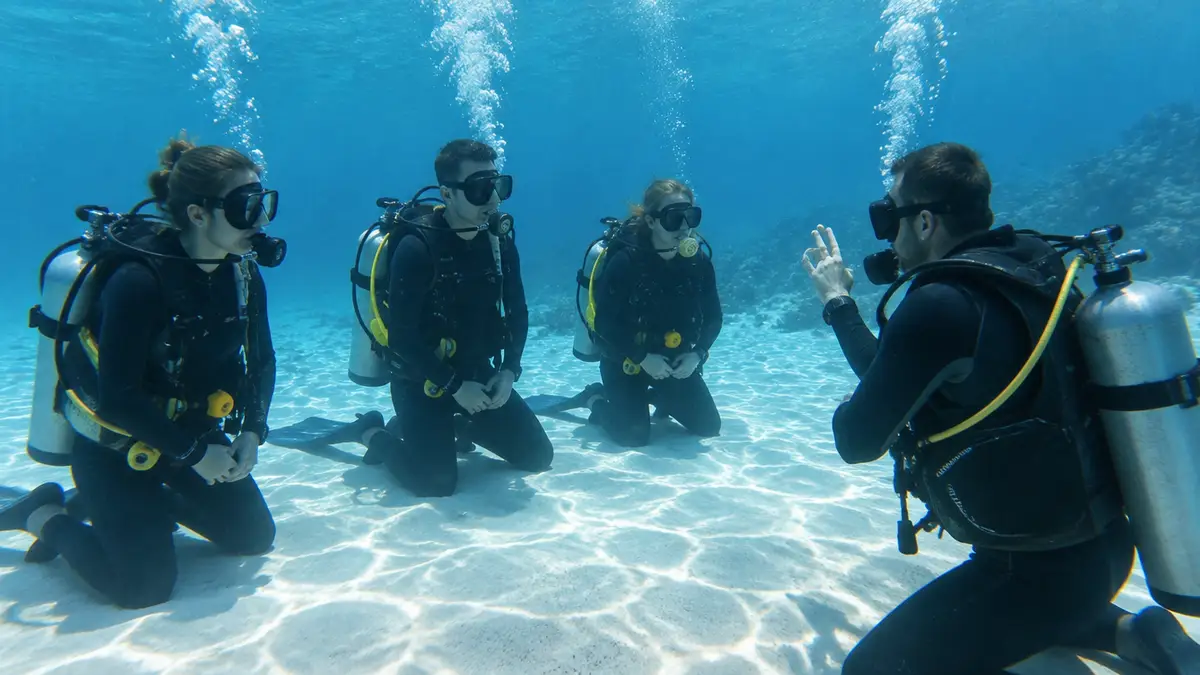
Being a certified diver isn't the same as being a qualified instructor. Instructors are trained to teach, supervise and handle student emergencies, and they're insured to do so. A friend who means well can't legally or practically replace that. If you want to try, book a proper Discover Scuba session. It's affordable and safe.
Frequently asked questions
Can you scuba dive without a certificate?
Only as part of a supervised programme with an instructor, such as Discover Scuba Diving. Reputable dive centres won't rent equipment, fill tanks or take you on dives without proof of certification.
Is it dangerous to use scuba gear in a swimming pool without training?
Yes. Lung overexpansion injuries can happen when ascending from as little as 1–2 metres while holding your breath, which is exactly the depth of a pool.
What is the most important rule in scuba diving?
Breathe continuously and never hold your breath. Close behind: ascend slowly, check your air often, and always dive with a buddy.
Keep reading
PADI vs SSI vs CMAS vs NAUI: Which Scuba Certification Should You Choose?
How the big training agencies differ and whether it matters for you (spoiler: less than you think).
Open Water Diver Course: What You Learn, How Long It Takes and What It Costs
Theory, pool sessions, four open-water dives: a day-by-day look at your first scuba certification.
After Open Water: Advanced, Rescue and Specialty Scuba Courses Explained
Advanced Open Water, Rescue Diver, nitrox, night, wreck and deep: what each course gives you.