Freediving for Beginners: What It Is, How to Start and How to Stay Safe
Freediving means exploring underwater on a single breath: silent, graceful and minimal. It's a separate sport from scuba, with its own training and safety rules.
On this page
Shallow-water blackout, a sudden loss of consciousness from low oxygen, can happen without warning, often near the surface. It's the main cause of freediving deaths. Always freedive with a trained buddy watching you from the surface, one up, one down. Take a proper course before practising breath-hold diving.
What is freediving?
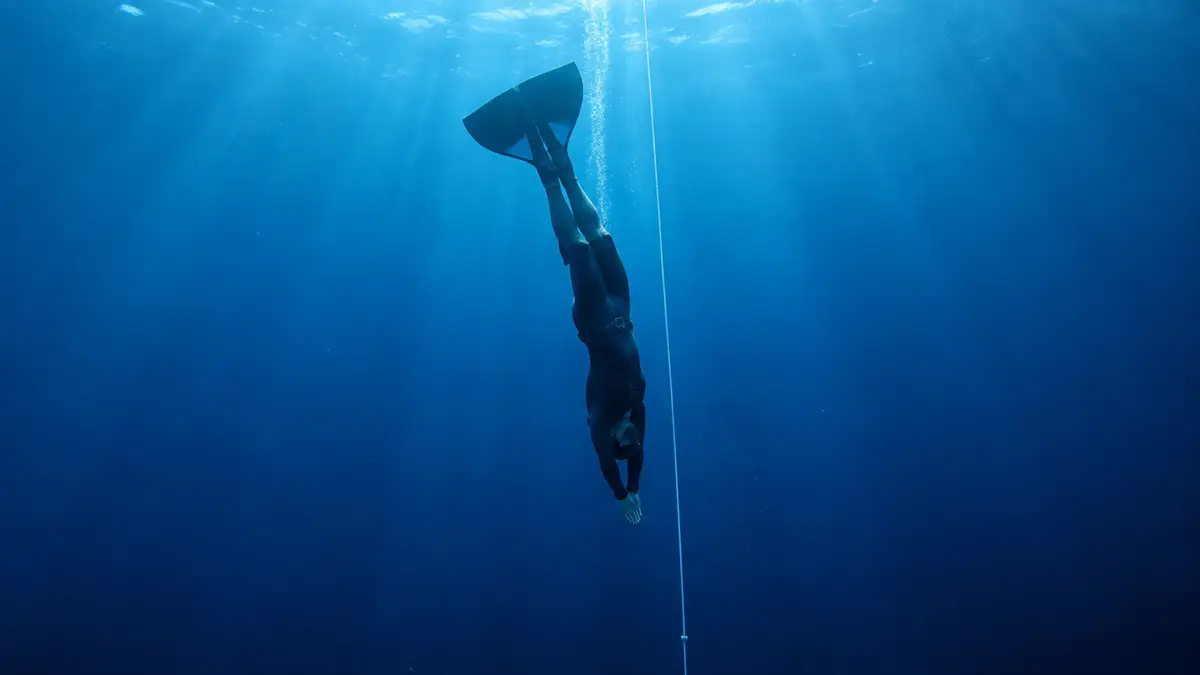
Freediving (or apnea) is diving while holding your breath: no tank, no bubbles, just you and the water. Recreational freedivers typically explore reefs at 5–20 m. Competitive athletes go far deeper. Freediving is quiet, so fish and marine mammals often let you get closer. Many people also love its mental side: relaxation, focus and body awareness.
Freediving vs scuba
| Freediving | Scuba | |
|---|---|---|
| Breathing | One breath per dive | Continuous from a tank |
| Time underwater | Typically 30 s–2 min per dive for recreational divers | 45–60 min |
| Gear | Low-volume mask, snorkel, long fins, wetsuit, weight belt | Full scuba kit |
| Main risks | Blackout, lung/ear squeeze | DCS, lung overexpansion, out of air |
| Feel | Silent, athletic, meditative | Relaxed, longer exploration |
Many people do both. Freediving skills (relaxation, equalization, finning) make you a better scuba diver, and vice versa.
Freediving disciplines
- Constant Weight (CWT): diving down and up along a line using fins or a monofin, without pulling on the line.
- Constant Weight No Fins (CNF): using breaststroke-style movements only.
- Free Immersion (FIM): pulling yourself down and up the line with your arms.
- Static Apnea (STA): holding your breath face-down at the surface, usually in a pool.
- Dynamic Apnea (DYN): swimming horizontally underwater in a pool.
Recreational freedivers mainly enjoy "fun freediving": exploring reefs, wrecks and marine life on a breath.
How freediving works in the body
When you hold your breath and put your face in cool water, your body triggers the mammalian dive reflex: your heart slows and blood shifts towards your vital organs, conserving oxygen. Training teaches you to relax, breathe efficiently before a dive, equalize without using much air (for example with the Frenzel technique), and recognise your limits.
Learning to freedive
Agencies such as AIDA, Molchanovs, PADI Freediver, SSI Freediving and CMAS offer courses. A typical level 1 course takes 2–3 days:
- Theory: physiology, safety, equalization, blackout
- Breathing and relaxation techniques
- Pool sessions: static and dynamic apnea
- Open water sessions: line diving to about 10–20 m
- Rescue skills: how to spot and help a buddy who blacks out
Popular freediving destinations include Dahab (Egypt), Kalamata (Greece), Panglao and Moalboal (Philippines), Gili and Amed, and Dean's Blue Hole in the Bahamas.
Essential safety rules
- Never freedive alone. Always use the one-up, one-down system, with your buddy watching from the surface.
- Never hyperventilate before a dive. It masks the urge to breathe and greatly increases blackout risk.
- Do recovery breaths after surfacing, and your buddy watches you for at least 30 seconds.
- Use a line and a buoy in open water.
- Build depth gradually and don't push your limits.
- Weight yourself correctly: you should be positively buoyant at the surface.
- Don't freedive right after scuba diving. Leave a long interval, since combining them can increase decompression risk.
Freediving gear
- Low-volume mask: less air needed to equalize.
- Long-blade fins (plastic, fibreglass or carbon) for efficient kicking.
- Open-cell wetsuit: warm and flexible (needs lubrication to put on).
- Rubber weight belt worn on the hips, with a quick release.
- Freediving computer or watch with apnea mode.
Try-freediving and first steps
Many freediving schools offer a half-day or one-day discovery session: breathing and relaxation on land, a static breath-hold in the pool, and a few line dives to 5–10 m in open water. It's a great way to see whether freediving is for you before a full course. You can also practise the basics safely while snorkeling: slow finning, relaxed breathing and gentle equalization. Always keep breath-hold dips short, with a buddy watching.
Frequently asked questions
Is freediving dangerous?
It can be if done alone or without training, mainly because of shallow-water blackout. With proper training and a trained buddy, recreational freediving is much safer.
How long can beginners hold their breath?
Many people can hold a relaxed static breath for 2–3 minutes after a beginner course, but recreational freedives are usually much shorter, often 30 seconds to a minute.
Keep reading
Scuba Diving with Kids: Minimum Ages, Programmes and Safety Tips
Minimum ages, kids' programmes and how to tell whether your child is ready.
Liveaboard Dive Safaris: What They Are, Who They Suit and How to Choose
Eat, sleep, dive, repeat: how dive safaris work and whether you're ready for one.
Snorkeling for Beginners: How to Start, What Gear You Need and Safety Tips
Not ready for scuba? Snorkeling shows you the reef with minimal gear and no training.