Scuba Diving Hand Signals: The Essential Signals Every Beginner Needs
Underwater, hand signals are your language. A dozen core signals cover almost every situation a new diver will face.
On this page
Hand signals let you talk to your buddy and guide underwater. Most are standardised across agencies, but there are regional differences, especially for air-pressure numbers. Always review signals in the briefing before diving with someone new.
How to signal well
- Make signals clear, deliberate and in front of your chest, where your buddy can see them.
- Get attention first: a tap, a tank bang or a torch wave.
- Wait for a response. A question like "OK?" should be answered with "OK" or a problem signal.
- At night, light your hand with your torch so the signal can be seen.
The essential signals
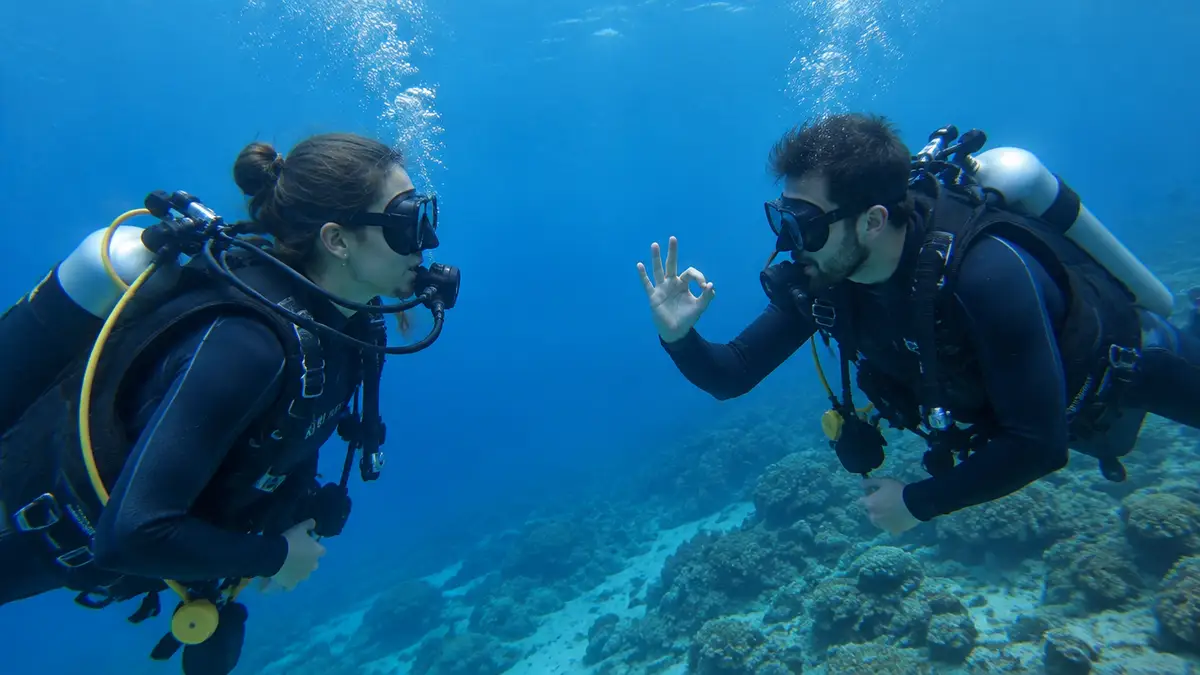
- OK / Are you OK? Thumb and index finger form a circle, other fingers extended. It's both a question and an answer. (Don't use thumbs-up for "OK"!)
- Something is wrong Flat hand, palm down, rocked side to side (like "so-so"), then point to the problem (ear, mask, etc.).
- Go up / End the dive Closed fist with thumb pointing up. This is not "OK"; it means "let's ascend".
- Go down Closed fist with thumb pointing down.
- Stop / Hold Flat hand, palm facing your buddy, like a traffic officer. Or a closed fist held up.
- Slow down Flat hand, palm down, moved gently downward several times.
- Level off / Stay at this depth Flat hand, palm down, moved horizontally side to side.
- Low on air Closed fist placed against your chest (often at your agreed reserve pressure).
- Out of air Flat hand making a slicing motion across your throat. An emergency.
- Share air / Give me your octopus Fingers pointing to or touching your mouth (or regulator), sometimes combined with the out-of-air signal.
- Check your air / How much air? Two fingers tapping the palm of the other hand, or pointing at the gauge.
- Buddy up / Stay together Two index fingers held side by side.
- Look / Watch Two fingers pointed at your eyes, then at the object.
- Ear problem / Can't equalize Point to your ear, then the "something is wrong" signal.
- Cold Arms crossed over your chest, rubbing your upper arms.
- Turn around / Change direction Index finger making a circle, then point the new direction.
- Safety stop Three fingers held above a flat hand (3 minutes at 5 m), or a flat hand over spread fingers.
- Which direction? Pointing with a flat hand, like a knife.
Communicating air pressure
How you signal numbers varies by region and agency. A common method:
- Show fingers for the tens: e.g. 1 finger + 0 (a fist or "O") = 100 bar; 5 fingers + 0 = 50 bar.
- Some divers use one hand vertical for "1" then a closed fist for "0" to make "100".
- In psi countries, numbers mean thousands and hundreds (for example 1-5-0-0 psi).
Also agree on half-tank and reserve signals, and when you'll begin the ascent. See low-air procedures.
Surface signals
- OK at the surface: one arm raised to form a circle with fingertips touching the top of your head, or both arms forming a large circle over your head (visible to the boat).
- Help / Emergency at the surface: arm waved vigorously side to side. Use your whistle too.
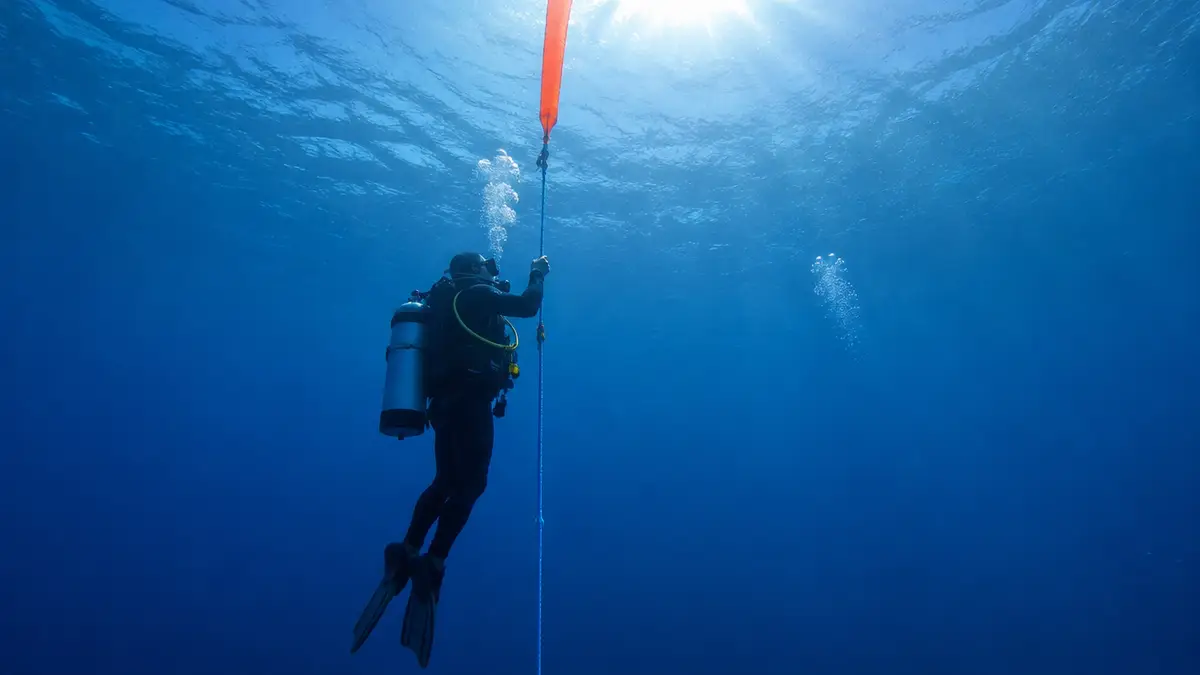
- Pick me up: an inflated SMB held upright.
Common marine life signals
These vary between guides, but you'll often see:
| Animal | Typical signal |
|---|---|
| Shark | Flat hand vertical on top of your head, like a dorsal fin |
| Turtle | One hand flat on the back of the other, thumbs moving like flippers |
| Ray / manta | Flat hands wide, "flapping" like wings |
| Moray eel | Hand opening and closing like a mouth |
| Octopus | Fingers dangling downward and wiggling |
| Lionfish | Fingers spread out from your head or arms like spines |
| Nudibranch | Two fingers on the back of the hand like antennae |
| Clownfish | Open hand in front of your face, wiggling fingers |
Torch (light) signals at night
- OK: slow circle with the torch beam.
- Attention / problem: rapid side-to-side movement.
- Look here: hold the beam steadily on the object (briefly).
Frequently asked questions
Does thumbs-up mean OK in scuba diving?
No. Thumbs-up means "go up / end the dive". The OK signal is a circle made with your thumb and index finger.
What is the signal for low on air?
A closed fist held against your chest. "Out of air" is a flat hand slicing across your throat.
Are hand signals the same in every country?
The core safety signals are largely universal, but air-pressure numbers and marine life signals can differ. Review them in every briefing.
Keep reading

Buoyancy and Breathing: Never Hold Your Breath, Save Air and Hover Like a Pro
Why you never hold your breath, how to find neutral buoyancy and how to make your air last longer.
How to Ascend Safely: Ascent Rate, the Safety Stop and Surfacing
Ascent speed, the 3-minute safety stop and how to surface without drama.
What to Do If… Mask Fogs, You Run Low on Air, Lose Your Buddy or Hit a Current
Calm, practical responses to the most common underwater problems.