Dangerous Marine Life for Divers (and the Truth About Sharks)
Films taught us to fear sharks. In reality, the animals that injure divers are mostly small, slow and hidden, and almost all incidents happen when people touch or step on them.
On this page
The ocean is not a hostile place for a careful diver. Marine animals don't hunt humans. When injuries happen, it's almost always because a diver touched, stepped on, cornered or provoked something. Follow the don't-touch rule and keep good buoyancy, and your risk is tiny.
The real everyday hazards
Fire coral and hydroids
Fire coral isn't a true coral. It's a hydrozoan with stinging cells, usually mustard-yellow to brown with white tips. Touching it gives a painful, burning rash. Hydroids look like fine feathers or ferns and sting similarly. Treatment: rinse with seawater (not fresh water), remove any fragments carefully, and apply vinegar if recommended locally. Seek help for severe reactions.
Sea urchins
The long-spined black urchin is common on reefs and in shallow water, and a hazard for shore entries and careless knees. Spines break off in the skin. Prevention: wear boots and watch where you put hands and knees. Treatment: remove visible spines; soak in hot (not scalding) water for pain; see a doctor if spines are deep or near joints.
Scorpionfish and stonefish
Masters of camouflage. They sit motionless on reefs and look like rocks. Their dorsal spines carry venom that causes intense pain; stonefish venom can be medically serious. Prevention: never put your hands or knees down on the reef or bottom. Treatment: immerse the wound in hot water (as hot as tolerable without scalding, around 45 °C) for 30–90 minutes, and get urgent medical care. Antivenom exists for stonefish.
Lionfish
Beautiful and slow-moving, with venomous spines. They're invasive in the Caribbean and Atlantic. They rarely sting divers unless touched or cornered. Treat like a scorpionfish sting (hot water, medical help).
Jellyfish
Most cause mild stings; a few, such as box jellyfish and Irukandji in tropical Australia and parts of Southeast Asia, can be dangerous. Prevention: wear a full wetsuit or "stinger suit" in affected areas and seasons (for example northern Australia roughly November to May), and follow local advice. Treatment: for box jellyfish, pour vinegar on the sting, and call emergency services. Treatment advice differs by species and region, so ask the local dive centre.
Cone snails
Beautiful shells with a harpoon-like venomous tooth. Some species can be deadly. Simply don't pick up shells, ever.
Animals that bite (if provoked)
Titan triggerfish
Perhaps the most "aggressive" fish divers meet. During nesting season, titan triggerfish defend a cone-shaped territory that extends upward from their nest. They may charge and bite fins or heads. What to do: swim horizontally away from the nest, not upward (their territory is cone-shaped), and keep your fins between you and the fish.
Moray eels
Morays open and close their mouths to breathe, which looks threatening but isn't. They bite only when harassed or when hand-fed. Don't put your hands into holes.
Barracuda
Big teeth and a curious stare, but barracuda very rarely bite divers. Avoid wearing shiny jewellery in murky water.
Sea snakes
Highly venomous but generally docile and curious. Bites on divers are very rare. Stay calm, keep still or move slowly away, and never grab them.
Crocodiles, seals, and others
Saltwater crocodiles are a real risk in some northern Australian, Indonesian and Pacific waters, and dive operators avoid those areas. Sea lions and seals are playful but can nip, especially males in breeding season.
The truth about sharks
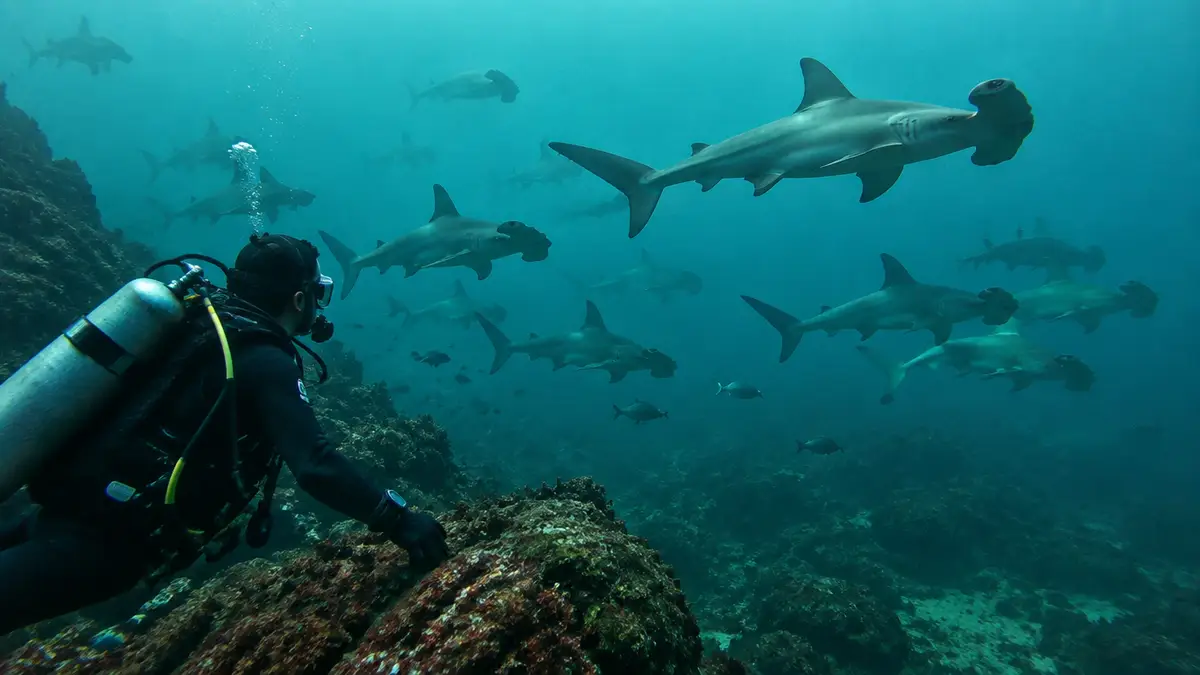
Most divers who see a shark feel lucky, not scared. Here's the reality:
- Shark incidents involving scuba divers are extremely rare. Most reported shark bites involve surfers and swimmers at the surface, often in murky water.
- Most reef sharks (whitetip, blacktip, grey reef, nurse sharks) are shy and usually keep their distance from divers.
- Sharks are threatened. Tens of millions are killed every year, largely for fins and through bycatch. Healthy shark populations are a sign of a healthy reef.
- Large species like tiger, bull and great white sharks deserve respect. Encounters with them are usually on organised dives with strict protocols.
Behaviour around sharks
- Stay calm, stay close to your buddy and the reef, and stay low in the water column
- Keep eye contact with larger sharks and don't turn your back on a curious one
- Don't chase, corner, touch or feed them
- Exit the water calmly if a shark behaves agitatedly (hunched back, pectoral fins dropped, zig-zag swimming)
- Avoid spearfishing near other divers and never carry bleeding fish
Want to see sharks? Read where to see big marine life.
First aid basics
- Know where the boat's first-aid kit and oxygen are.
- For venomous fish spines: hot-water immersion and medical help.
- For jellyfish: follow local protocol (vinegar for box jellyfish in the tropics).
- For allergic reactions (difficulty breathing, swelling): call emergency services immediately.
The Rescue Diver and first aid courses teach these properly. See Rescue Diver.
Frequently asked questions
Are sharks dangerous to scuba divers?
Very rarely. Most sharks avoid divers, and incidents are extremely uncommon. Following local guidelines and not feeding or harassing sharks keeps the risk tiny.
What is the most dangerous animal for divers?
In practice, small camouflaged animals like stonefish, scorpionfish and some jellyfish cause more injuries, because divers touch or step on them. Not touching anything prevents most injuries.
What should I do if a triggerfish charges me?
Swim horizontally away from its nest, not upward, and keep your fins between you and the fish.
Keep reading
The Buddy System: Why You Never Dive Alone and How to Be a Good Buddy
Why you never dive alone, how to stay together, and the lost-buddy procedure.
Scuba Diving Hand Signals: The Essential Signals Every Beginner Needs
OK, problem, low on air, up, down: the underwater signals you need, and how to use them.
Buoyancy and Breathing: Never Hold Your Breath, Save Air and Hover Like a Pro
Why you never hold your breath, how to find neutral buoyancy and how to make your air last longer.